Dimensional analysis vs. formula method: which should I use for medication math?
A neutral comparison of dimensional analysis, formula-based dosage calculation, and ratio-proportion methods, with a focus on consistency, units, and error checking.
There is no universal winner for every learner
Medication-calculation education has used several methods, including traditional formula approaches, ratio-proportion, and dimensional analysis/factor-label methods. A method is useful when the learner can apply it consistently, explain the relationships, keep units visible, and recognize implausible results.
See the same medication-math relationship three ways.
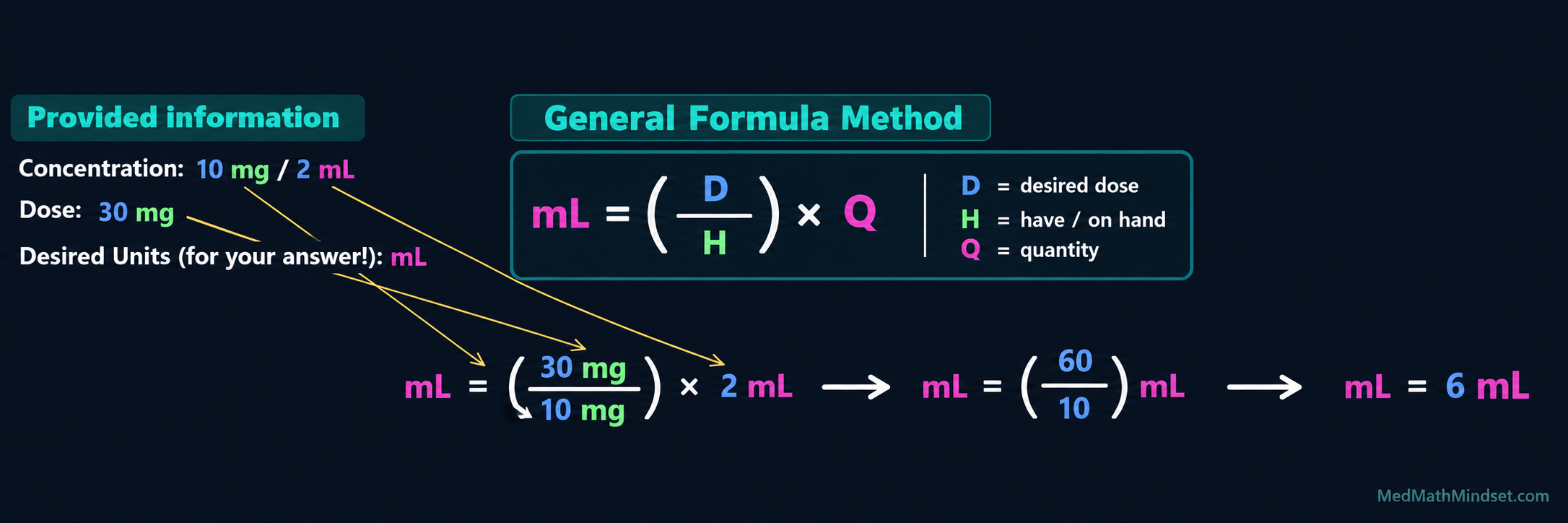
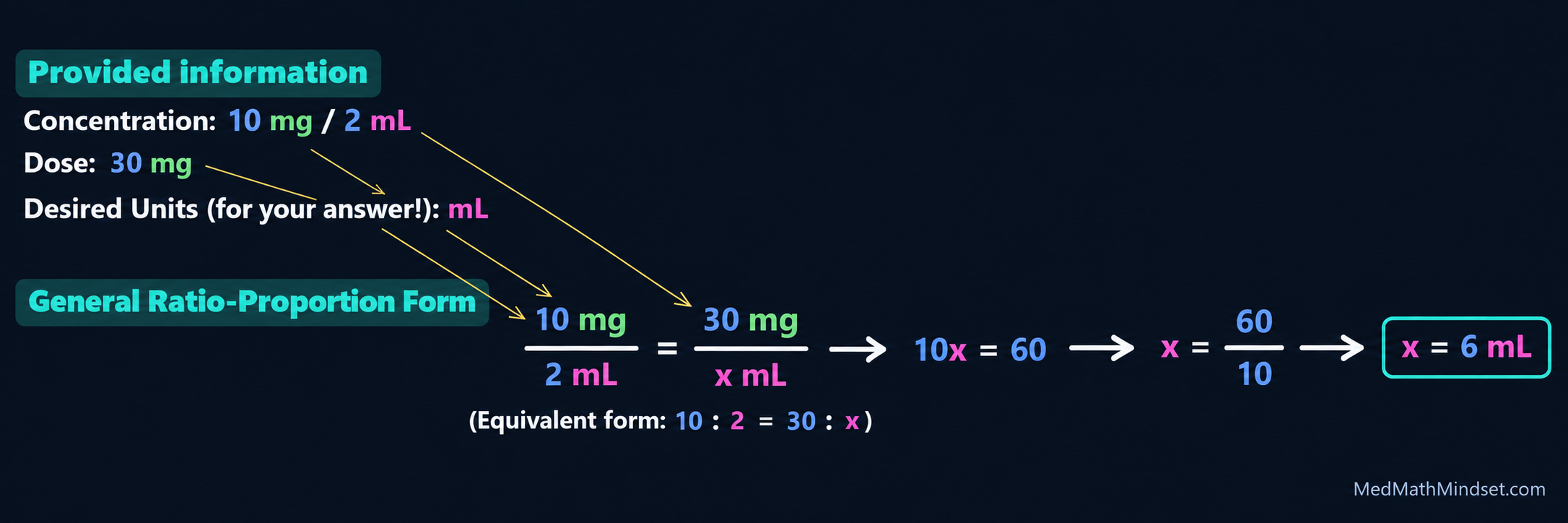
Each example uses the same information—10 mg in 2 mL with a desired dose of 30 mg—and reaches the same answer: 6 mL. The visual difference is the setup, not the underlying relationship.
Formula method
Use Desired ÷ Have × Quantity, while keeping the units visible and compatible.
Ratio-proportion
Set two equivalent relationships and solve for the unknown quantity.
Dimensional analysis
Choose a conversion factor that cancels the unwanted unit and leaves the requested unit.

Formula method
A common form is desired ÷ have × quantity. It can be efficient for familiar tablet and liquid problems. Its weakness is that learners may insert numbers mechanically without noticing mismatched units unless unit checks are made explicit.
Ratio-proportion
Ratio-proportion expresses equivalent relationships and solves for an unknown. It can make proportional reasoning visible, but students who are not comfortable with ratios may add unnecessary algebra or cross-multiply without understanding what the quantities represent.
Dimensional analysis
Dimensional analysis builds a chain of conversion factors so unwanted units cancel and the desired unit remains. It is especially useful when several conversions are required. The setup can look longer at first, but the units themselves provide a built-in structural check.
Choose consistency before speed
Early in learning, switching methods every item can increase cognitive load. Choose one defensible method, learn why it works, and practice it until the structure is stable. Then learn to recognize equivalent methods so a different instructor or textbook notation does not become a new obstacle.
Regardless of method
State the target unit, make units compatible, estimate the magnitude, calculate, and apply the required rounding rule. The method should support those safety habits rather than replace them.
Educational scope
This page is for learning and study. Use your instructor, current credentialing blueprint, employer policy, medication reference, protocol, and clinical judgment as the governing sources for real patient care.