Why can healthcare math feel different under pressure?
Why a learner may understand healthcare math in practice yet perform differently under time pressure, observation, or exam conditions—and how to train the performance side.
Read →Short, evidence-informed explanations designed to help you understand the gap between knowing a calculation and performing it reliably when context, timing, or pressure changes.
Open eight free interactive performance labs for dosage calculations, dimensional analysis, weight-based dosing, mcg/kg/min, IV drip rates, infusion rates, reconstitution, and oxygen-cylinder duration. No account required.
Open a provider-specific guide for Medical Assisting, CNA, EMT, Paramedic, nursing, respiratory therapy, pharmacy, imaging, dental, sleep, surgical technology, and sonography. Each guide is designed to print cleanly or save as a PDF with MedMathMindset.com retained.
Compare formula method, ratio-proportion, and dimensional analysis using the same concentration and desired dose. Each reaches 6 mL when the setup is correct.
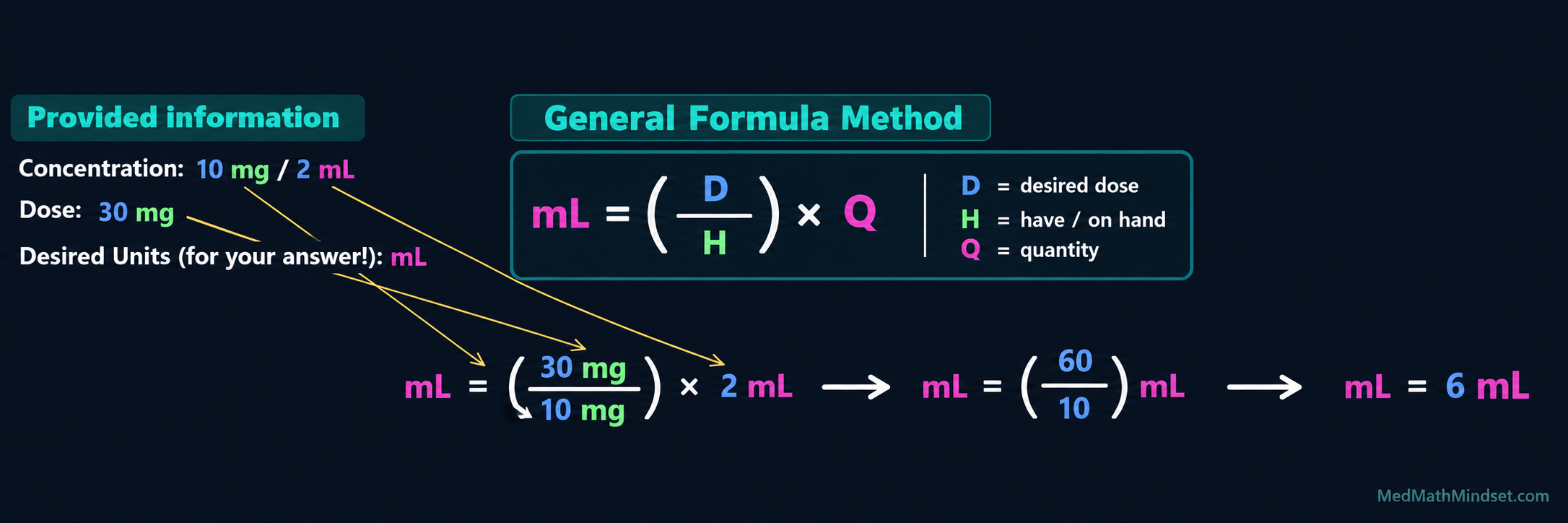
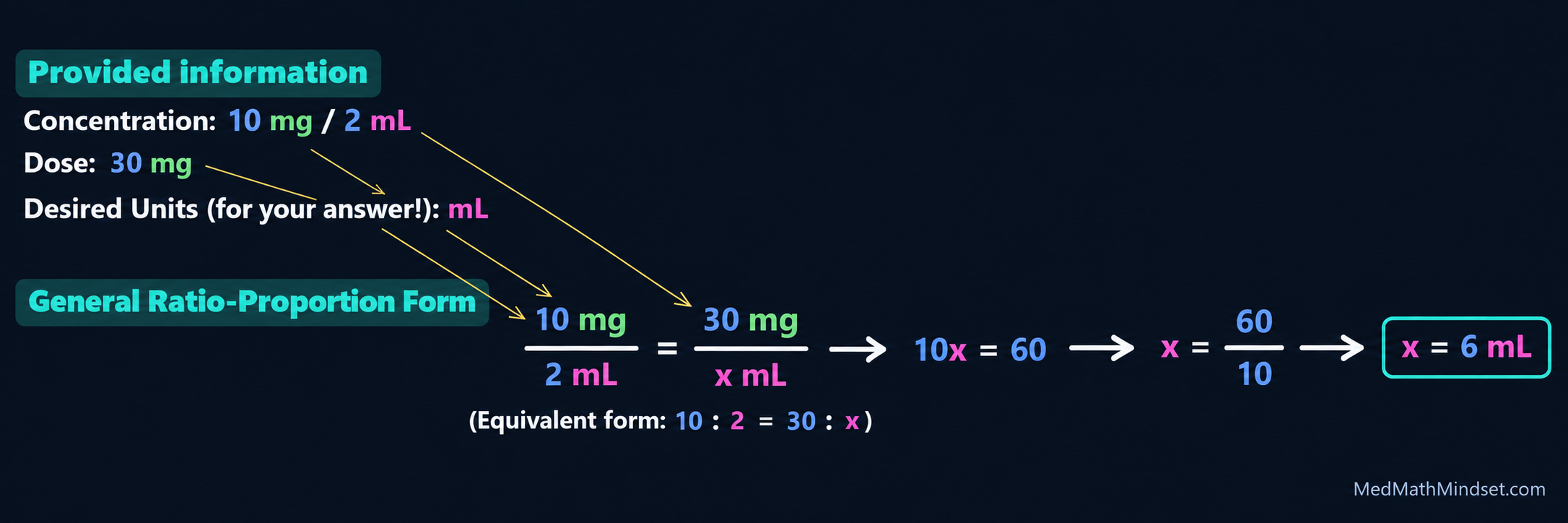

All three methods are open together so you can compare the full setups without horizontal scrolling. Collapse any method you do not need, or use the comparison page for a guided explanation.
Why a learner may understand healthcare math in practice yet perform differently under time pressure, observation, or exam conditions—and how to train the performance side.
Read →A practical explanation of why dosage-calculation performance can change on exam day and how to build more reliable retrieval without simply doing endless worksheets.
Read →How active retrieval differs from rereading and why health-professions education research supports using retrieval as part of medication-math study.
Read →A plain-language explanation of cognitive load in healthcare-math problems and practical ways to reduce avoidable mental clutter without lowering standards.
Read →Why confidence should be compared with actual performance and how learners can train the difference between uncertainty, guessing, and reliable mathematical judgment.
Read →A five-part reasonableness check for healthcare math: target unit, order of magnitude, direction, concentration, and final rounding.
Read →A practical way to build unit-conversion fluency without memorizing disconnected tricks: anchors, unit cancellation, estimation, mixed retrieval, and spacing.
Read →A neutral comparison of dimensional analysis, formula-based dosage calculation, and ratio-proportion methods, with a focus on consistency, units, and error checking.
Read →A focused CCMA healthcare-math practice framework built around measurements, dosage calculations, conversions, numeracy fluency, and performance under pressure.
Read →A paramedic medication-math practice framework covering conversions, concentration, weight-based dosing, infusion relationships, scenario recognition, and pressure-ready retrieval.
Read →A nursing dosage-calculation practice sequence that connects numeracy, method consistency, retrieval, reasonableness checks, and progressive application.
Read →A safe study strategy for no-calculator healthcare math: estimation, anchor facts, written structure, unit cancellation, and progressive speed.
Read →What health-professions education research says about distributed practice, and how to use short spaced sessions without losing the benefits of longer problem-solving practice.
Read →An educator brief for separating knowledge gaps from performance-access problems and creating low-lift practice that progresses from accuracy to reliable retrieval under demand.
Read →Why quantity alone can fail to improve medication-math performance, and how error classification, retrieval, spacing, feedback, and varied context make practice more informative.
Read →See MedMathMindset's Evidence & Editorial Standards for source hierarchy, scope, and claim discipline.
Use the cornerstone guide for the big picture, then move into the medication-calculation foundation that matches the skill you are trying to strengthen.
Healthcare Numeracy: What It Is, Why It Matters, and Why Knowing the Math Is Not Always Enough →